Meshy releases Meshy 7, a new foundation model that sets a new bar for image-3D alignment
Meshy 7 is built around a single standard: the 3D result should agree with the image the user brought. Meshy is also publishing how it measures that agreement — geometry scored directly against reference models held out of training, not by human preference or a vision-language judge.
SILICON VALLEY, Calif., Aug. 12, 2026 /PRNewswire/ -- Meshy has released Meshy 7, its new image-to-3D foundation model, together with the method behind a new 3D geometry alignment benchmark and its first results.
WHY ALIGNMENT MATTERS NOW
The first problem with image-to-3D was whether a model could produce a usable asset at all. Broken surfaces, scrambled structure and missing limbs are now rare enough among leading models that not breaking differentiates very little.
So the question that matters has changed. An asset can look entirely reasonable and still fail to reproduce the reference: a body slightly too wide, a hand shifted out of place, an engraved line from the source image simply gone. Nothing is obviously wrong, and it is not what the user designed. That is alignment, and it separates a good 3D model from one that merely does not break.
INDUSTRY-LEADING ALIGNMENT
Given a single input image, Meshy 7 leads every model tested on all three aspects of alignment: 81.0% on overall proportion, 79.7% on spatial distribution, 59.8% on surface details — measured against four competing 3D foundation models on reference 3D models excluded from training, where 100% is the reference measured against itself. The pattern holds under the front view, the strictest condition, where Meshy 7 leads on aggregate and on each metric individually.
The lead is widest where the problem is hardest. Overall proportion is close across leading models now. Surface details is not — under single-view input no model tested reaches 60% — and this is where Meshy 7 pulls furthest ahead: 5.3 points clear of the closest competitor, more than twice its margin on either of the other two aspects. That is the shape of a real lead: not a fraction of a point where the field is already bunched together, but daylight on the dimension nobody has solved.
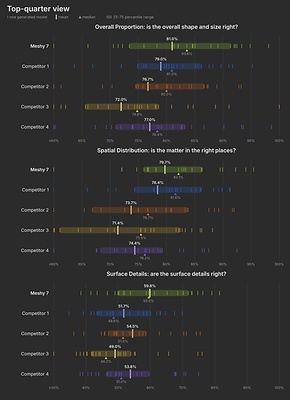
With four views the field converges: every model improves, and extra views help most on spatial distribution and surface details, the dimensions most affected by hidden geometry. The leaders end up within roughly two points of one another, and Meshy 7's single-view lead is large enough that the closest competitor catches up rather than clearly overtakes it. Single-view input is where systems separate — and it is the condition most users are in.
Compared with Meshy 6, Meshy 7 improves alignment clearly on both geometry and texture. The benchmark above covers geometry; texture is measured separately.
WHERE THE DIFFERENCE SHOWS
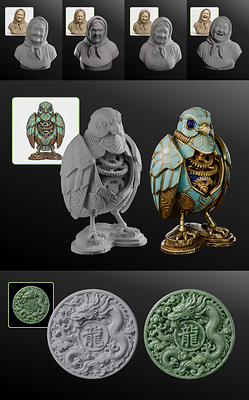
- Faces. A small geometric change is enough to alter an expression, which makes faces one of the hardest alignment tests. Across a set of portrait busts, Meshy 7 does not settle for a generic face: cheeks lift and laugh lines deepen on a smile, the brow tightens and the mouth turns down on a stern look, the face relaxes on closed eyes — while headscarf, knot and clothing stay stable.
- Part relationships. A mechanical object only reads as mechanical when every component sits where it belongs. On a clockwork owl of layered wing armour, exposed gears and thin legs, Meshy 7 keeps the parts distinct and placed as the concept places them, rather than collapsing the design into a bird-shaped mass.
- Dense surface relief. A jade medallion is almost entirely shallow relief — a dragon coiling the outer ring, dense cloud pattern, a raised centre motif, all on a nearly flat disc. Meshy 7 keeps the pattern continuous rather than fragmented, at the depth the image gives it.
Three changes got it there. The image encoder now reads the input at multiple scales and accepts higher resolution, so fine shape information survives into generation instead of being averaged out. The training data was rebuilt to a stricter standard, every sample corresponding exactly to its target geometry with style, lighting and background removed. And geometry alignment became a tracked signal inside every training cycle rather than an evaluation applied at the end — the capability users care about and the number the team optimises against are now the same number.
HOW ALIGNMENT IS MEASURED
The benchmark uses neither human preference nor a vision-language judge; it compares 3D geometry directly.
Reference 3D models held out of training are rendered into input images using known cameras. Each generative model produces a 3D result from those images, which is compared against the original reference geometry — so every test image has a known 3D correct answer. Comparing renders instead would mean estimating the source camera first, mixing camera error into the geometry error being measured.
Before scoring, each generation is aligned to its reference by translation, rotation and uniform scaling only — never stretched along a single axis, so a model's own proportion errors cannot be corrected away. Agreement is then measured at three levels, from overall structure down to fine geometric difference. The reference set spans characters, vehicles, sculptures and thin-structure props, tested under three input conditions: front view, raised top-quarter view, and four views combined.
AVAILABILITY AND WHAT COMES NEXT
Meshy 7 went live on 10 August, open to all Meshy subscription tiers; downloading generated models requires the Pro tier or above. Ultra Mode currently supports single-view generation, with multi-view support arriving shortly. The benchmark described here will be released separately after launch. Geometry is only part of image-to-3D alignment — colour, material and pattern have their own — and a dedicated texture alignment benchmark will follow.
 View original content to download multimedia:https://www.prnewswire.co.uk/news-releases/meshy-releases-meshy-7-a-new-foundation-model-that-sets-a-new-bar-for-image-3d-alignment-302849385.html