LG ELECTRONICS UNVEILS THE NEXT EVOLUTION OF AI HOME AT IFA 2026
Introducing ThinQ Claw and Expanded AI Home Experiences
Powered by Contextual Intelligence
News Summary
- LG unveils the next evolution of AI Home at IFA 2026, leveraging upgraded contextual intelligence to recommend relevant actions, coordinate connected devices and services, and deliver a more personalized experience.
- The brand-new ThinQ Claw introduces text-chat-based interactions to AI Home, comprehending intent and context to provide tailored, situationally-appropriate support and enhanced customer value.
- Visitors to IFA can explore an expanded AI Home ecosystem spanning intelligent home and energy management solutions and learn about LG's AI-powered ThinQ Pro for shared and commercial spaces, which is making its European debut.
SEOUL, South Korea, Aug. 31, 2026 /PRNewswire/ -- LG Electronics (LG) is unveiling the next evolution of its AI Home at IFA 2026. Bringing together AI-powered appliances, connected services and contextual intelligence, LG AI Home simplifies daily routines, enhances convenience and delivers a more personalized and intuitive customer experience.
A Home That Understands You
LG AI Home analyzes schedules, routines, the home environment and appliance usage to recommend appropriate actions and optimize coordination between devices and services. By providing personalized suggestions based on real-world context, it proactively supports customers to spend less time managing their appliances and more time enjoying life. To illustrate this vision at IFA 2026, LG invites visitors to explore immersive AI Home spaces—spanning living, kitchen and rest zones—where they can experience firsthand how LG's AI technologies coordinate devices and services around different everyday routines.
ThinQ Claw: Extending AI Home Through Chat and Contextual Intelligence
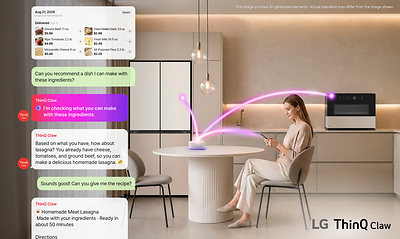
At IFA 2026, LG is introducing ThinQ Claw, a new text-chat-based AI agent experience that further enriches and expands the company's AI Home offering. Built on the concept of OpenClaw and optimized specifically for LG AI Home, ThinQ Claw can understand user intent and context and help complete tasks by connecting and coordinating relevant services and devices.
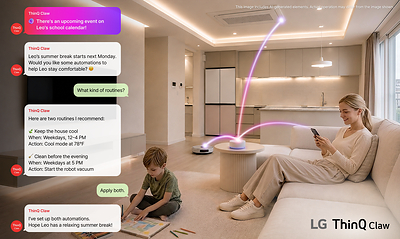
ThinQ Claw interprets updates shared by the user within the context of their life, rather than as isolated events. This enables it to recommend (or help initiate) appropriate actions aligned with personal preferences and the unique demands of each situation. It can manage cooking appliances to help the user prepare for hosting guests, monitor indoor air quality and temperature before the user arrives home to create a more comfortable environment based on current conditions, or suggest tailored experiences to entertain, empower or relax.
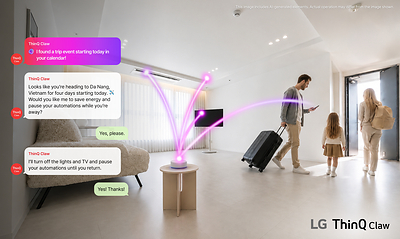
Beyond appliance control, ThinQ Claw works collaboratively with daily services like calendars and other connected services. Instead of requiring complex automation rules, it allows users to share their plans or current status through a natural chat interface. In addition to being able to understand requests and determine the necessary steps, ThinQ Claw can remember customers' likes and dislikes, leading to increasingly personalized experiences over time. This intelligent and context-aware agent expands how customers engage with AI Home by providing increasingly personalized support both inside and outside the home. ThinQ Claw will be demonstrated at LG's AI Home Zone throughout IFA 2026.
An Expanded AI Home Ecosystem
The AI Home Zone highlights LG's open AI Home ecosystem powered by Homey, a smart home platform developed by Athom, which LG acquired in 2024. With its broad interoperability across brands and connected devices, Homey enables a safe and reliable connected home experience.
Homey allows users to manage diverse products from different manufacturers and service providers in one place. Through a comprehensive Home Energy Management System (HEMS) demonstration, IFA visitors can observe how Homey intelligently orchestrates energy generation, storage and consumption in real time by connecting smart meters, solar panels, home batteries and EV chargers with LG appliances. HEMS can help reduce household electricity bills by optimizing when energy is generated, stored and consumed, while taking advantage of dynamic energy pricing where supported.*
IFA 2026 will also mark the European debut of LG ThinQ Pro. Designed for multi-family residential and commercial environments, ThinQ Pro supports the efficient management of devices and facilities while illustrating how LG's AI Home vision extends beyond the home into shared and professional spaces.
Applied across the entirety of the AI Home ecosystem, the LG Shield security framework helps protect connected appliances, services and customer data, enabling safe and secure AI experiences.
"ThinQ Claw marks the next step in LG AI Home, illustrating how AI can understand customer intent and life context to support a more personalized and streamlined daily experience," said Baek Seung-tae, president of the LG Home Appliance Solution Company. "LG will continue advancing AI Home through innovations that are increasingly intuitive and responsive to customers' needs."
* Results may vary depending on usage, energy tariffs and local conditions. |
About LG Electronics Home Appliance Solution Company
The LG Home Appliance Solution Company (HS) is a global leader in home appliances and AI home solutions. By leveraging industry-leading core technologies, the HS Company is committed to enhancing consumers' quality of life and promoting sustainability. The company develops thoughtfully designed kitchen and living appliance solutions and has recently integrated LG's Robot Business Division to incorporate advanced robot technologies into its home solutions. Together, these products offer enhanced convenience, exceptional performance, efficient operation and sustainable lifestyle solutions. For more news on LG, visit www.LG.com/global/newsroom/.
 View original content to download multimedia:https://www.prnewswire.co.uk/news-releases/lg-electronics-unveils-the-next-evolution-of-ai-home-at-ifa-2026-302864370.html