LG ELECTRONICS BEGINS MASS PRODUCTION OF 5G SMART TELEMATICS SOLUTION FOR A PREMIUM EUROPEAN AUTOMAKER
LG's Integrated Antenna and Communications Module Solution Enhances Connectivity, Design Efficiency and SDV Readiness
News Summary
- LG Electronics has begun mass production of its next-generation 5G R16-based smart telematics solution and commenced deliveries to a premium European automaker, marking the solution's first deployment in a production vehicle in Europe.
- By combining a communications module and up to 12 antennas into a single unit, the solution improves connectivity performance while reducing complexity, weight and cost.
- Built on LG's proprietary ATP, developed and refined over more than a decade, the solution enhances software reuse, development efficiency, stability and supply-chain flexibility.
- LG aims to establish the solution as core communications infrastructure for the SDV era, supporting OTA updates, V2X and autonomous-driving data transmission.
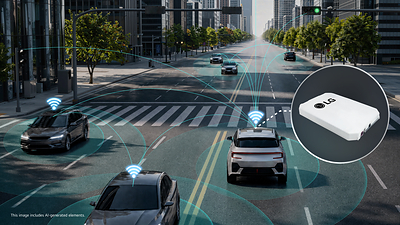
SEOUL, South Korea, Aug. 19, 2026 /PRNewswire/ -- LG Electronics (LG), the global market leader in telematics*, has begun mass production of its next-generation 5G Release 16 (R16)-based smart telematics solution, which integrates a communications module and (up to) 12 antennas into a single unit. LG has already commenced deliveries to a premium European automaker, marking the solution's first deployment in a production vehicle in Europe.
Addressing Growing Complexity in Vehicle Connectivity
Conventional vehicle communication systems typically rely on separate physical components: a telematics control unit and an externally mounted shark-fin antenna. Due to the ongoing expansion of vehicle connectivity capabilities, the number of antennas required to support the necessary communication technologies – including Multi-Frequency Global Navigation Satellite Systems (GNSS), Fifth-generation mobile communications (5G), Wi-Fi and Vehicle-to-everything (V2X)– has steadily risen.
This presents a major challenge for automakers, primarily because of the limited space available for external antennas. In particular, 5G communications need multiple antennas to ensure sufficient performance, but a standard shark fin is restricted in how many antennas it can accommodate. As a result, automakers are often forced to install additional antennas in multiple locations throughout the vehicle, increasing radio frequency (RF) cabling, wiring complexity, vehicle weight, and overall cost.
These structural limitations are especially significant for electric vehicles, where weight directly affects driving range and complex wiring architectures can have a major impact on production efficiency and cost competitiveness.
Advancing Telematics Through Integrated Hardware and Software
LG's smart telematics solution addresses these challenges by integrating the communications module and multiple antennas into a single unit. Built on 5G R16 communications technology, the solution has an optimized internal architecture capable of housing up to 12 antennas. This increased capacity helps reduce reliance on externally mounted antennas and cut down on RF cabling. Critically, the solution enables vehicles to maintain strong connectivity performance, while also contributing to improved structural efficiency.
To extend these benefits across a wide range of vehicle configurations, the solution adopts a modular architecture designed to accommodate diverse OEM requirements. Depending on configuration needs, the telematics and antenna boards can be combined or separated – enabling application versatility not only for new vehicle models, but existing vehicle platforms as well.
The solution also incorporates a scalable software platform designed to support deployment across diverse vehicle models. Built on LG's proprietary Automotive Telematics Platform (ATP), which has been developed and refined over more than a decade, the solution utilizes the same core software across supported applications, requiring only adjustments for chipset-specific interfaces.
This structure increases software reuse, improves development efficiency, and strengthens stability and compatibility across global communications environments. LG's solution has also been designed to support multiple communications chipsets, reducing dependence on any single component and mitigating supply chain risk.
Delivering Reliable Connectivity in Demanding Conditions
LG's smart telematics solution is designed to operate reliably, even in demanding high-temperature vehicle environments. Testing using real vehicles has verified the solution's ability to maintain stable data transmission and reception under extreme conditions, further reinforcing the reliability of in-vehicle communication systems.
Building on Decades of Antenna Integration Expertise
Achieving this level of communications performance and reliability requires more than advanced component specifications alone; it also depends on mechanical design, internal structure and metal placement, all of which can significantly influence thermal dissipation performance. Leveraging its extensive experience in integrated hardware, mechanical and antenna design – accumulated through decades of innovation in the mobile communications sector – LG has secured differentiated competitiveness in automotive communications systems.
Enabling Core Communications Infrastructure for the SDV Era
More than a component-level innovation, LG's smart telematics solution shifts vehicle communications architecture from a distributed antenna structure to an integrated communications platform. LG aims to establish its solution as core infrastructure for the software-defined vehicle (SDV) era, supporting over-the-air (OTA) updates, V2X and autonomous-driving data transmission.
As vehicle connectivity continues to advance, integrated telematics solutions are expected to play an increasingly important role in future vehicle architectures.
"Our smart telematics solution goes beyond hardware integration to redefine the underlying architecture of vehicle communications," said Eun Seok-hyun, president of the LG Vehicle Solution Company. "Leveraging its accumulated expertise in communications technologies and software, LG will continue to deliver integrated telematics solutions optimized for the SDV era."
** Source: TechInsights, based on market share estimates.
About LG Electronics Vehicle Solution Company
The LG Vehicle Solution Company (VS) is bringing LG's unique mobility innovations to the automotive industry. As a trusted and innovative partner, the company provides intelligent solutions including head units, displays, connectivity, ADAS vision systems, and software solutions integrating human-centered AI and automotive engineering into the modern AI/software-defined vehicle. Committed to "Driving better future mobility," the company has diversified its portfolio to further strengthen its capabilities, including automotive lighting systems, e-powertrain and cybersecurity. For more information, visit www.LG.com/global/mobility. To stay updated with the latest news, subscribe to the LG mobility newsletter, LG Loop at www.LG.com/global/mobility/newsletter and follow the LG VS Company LinkedIn channel at www.linkedin.com/company/lgvehiclesolution.
 View original content to download multimedia:https://www.prnewswire.co.uk/news-releases/lg-electronics-begins-mass-production-of-5g-smart-telematics-solution-for-a-premium-european-automaker-302853451.html