Fibocom Achieves 4Gb LPDDR4x Memory Optimization on FG550, Strengthening Cost and Supply Competitiveness for 5G Devices
SHENZHEN, China, June 23, 2026 /PRNewswire/ -- During MWC Shanghai 2026, Fibocom launched the storage-optimized FG550-EAU, a 5G module based on the Samsung Exynos Modem platform. The module optimizes its RAM configuration from LPDDR4x 8Gb to LPDDR4x 4Gb, streamlining RAM capacity by 50%, while retaining business functions and customer-specific customization capabilities.
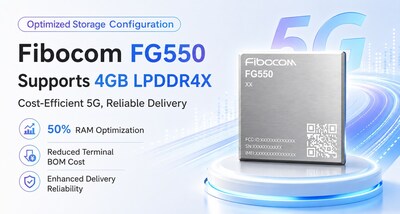
As AI server and data center demand intensifies memory shortages and price volatility, memory cost and availability have become key factors affecting 5G terminal commercialization. The optimization addresses cost control and stable delivery requirements in mass production, helping customers reduce terminal BOM costs, strengthen supply chain resilience, and improve deployment certainty.
Based on actual terminal operating requirements, Fibocom implemented refined RAM optimization through low-level code review, memory scheduling optimization, and precise system resource allocation, enabling stable deployment with the 4Gb configuration. The optimized FG550-EAU retains key product features, while improving resource utilization, operating experience, and power efficiency.
The FG550-EAU supports 3GPP Rel.16 and NR 5CC carrier aggregation. It is backward compatible with LTE Cat.20, supporting 4G/5G dual-mode connectivity across mainstream global networks.
"Samsung Exynos Modem and Fibocom share a strong and enduring partnership. This RAM optimization solution highlights Fibocom's outstanding engineering expertise and professionalism," said Xuebao Pan, senior vice president and head of System LSI R&D Center at Samsung Semiconductor China Research. "We highly value this breakthrough in balancing performance and cost, and look forward to continuing our collaboration to empower next-generation 5G terminals."
This storage optimization marks another customer-oriented technical innovation by Fibocom around mass-production requirements. Fibocom will continue to leverage its 5G connectivity, platform adaptation, and supply chain management capabilities to work with global FWA, mobile broadband, and IoT customers in building 5G terminal products with stronger cost competitiveness and delivery certainty.
About Fibocom
Fibocom is China's first wireless communication module company listed on both the A-share and H-share markets. As a global leading provider of wireless communication modules and AI solutions, Fibocom leverages wireless communication and artificial intelligence as its core technologies to provide integrated hardware and software solutions that empower industry applications.
Fibocom's one-stop solutions encompass cellular communication, AI, automotive, and GNSS modules, as well as AI toolchains, supporting industry-side and mainstream large model integration, and providing AI Agent, global connectivity, and cloud services, driving the digital intelligence upgrades in industries such as robotics, consumer electronics, low-altitude economy, intelligent transportation, smart retail, and smart energy.

Photo - https://mma.prnewswire.com/media/2998143/0ABB7C93_11C6_429C_93DA_2548B67F227E.jpg
Logo - https://mma.prnewswire.com/media/2429567/LOGO_Logo.jpg
 View original content:https://www.prnewswire.co.uk/news-releases/fibocom-achieves-4gb-lpddr4x-memory-optimization-on-fg550-strengthening-cost-and-supply-competitiveness-for-5g-devices-302806505.html