Antonony Gu, Huawei Cloud: All for AI, Huawei Cloud Stack Powers a New Era of Intelligence
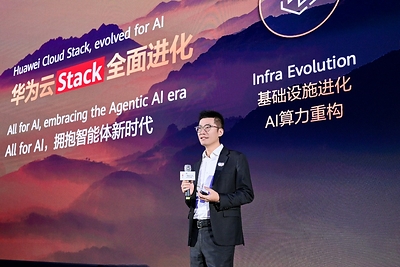
SHANGHAI, Sept. 18, 2026 /PRNewswire/ -- At HUAWEI CONNECT 2026, Huawei hosted the Huawei Cloud Summit under the theme "Agentic Hybrid Cloud: Powering a New Era of Intelligence." Antonony Gu, President of Huawei Hybrid Cloud, delivered a keynote speech at the summit, discussing the changes driven by AI agents, Huawei Cloud Stack's evolution across four key areas—cloud infrastructure, data, AI, and ecosystem—guided by the principle of "All for AI", and its commitment to helping enterprises embrace the agentic AI era.
AI agents are among the most significant developments in AI today. Agents for coding, workplaces, design, customer service, marketing, and more are rapidly redefining how businesses get done. Antonony Gu highlighted that the rapid adoption of AI agents is driving three fundamental changes:
- The actors driving business execution are changing: from humans using applications to human-agent collaboration and agent-to-agent (A2A) collaboration. AI agents are emerging at scale as a new class of digital employees.
- Resource provisioning is changing: AI agents are task-oriented, relying on compute, data, and models that are packaged and readily available for invocation. Resource delivery is shifting from layer-by-layer assembly to integrated capabilities organized around agent-driven tasks.
- What's being managed is changing: The focus is shifting from traditional IT resources, such as compute, storage, and networking, to AI compute, data, and models. Managing these resources through separate systems can create new IT silos.
Addressing these changes, Huawei Cloud has introduced an AI agent-ready hybrid cloud architectureNext, comprising four key capabilities: an agile, elastic cloud infrastructure designed for continuous evolution and unified general-purpose and AI compute; an AI-native capability hub that connects data, compute, and tokens; an agent-native enablement platform for developing and running AI agents at scale; and intelligent operations and end-to-end security capabilities covering the entire AI agent lifecycle. Antonony Gu emphasized, "As AI agent adoption continues to accelerate over the next three to five years, a deterministic hybrid cloud architecture is a clear path forward for enterprises in the agentic world."
As the agentic AI era approaches, Huawei Cloud Stack is evolving across four key areas: infrastructure, data, AI, and ecosystem.
- Infrastructure evolution, building the foundation for AI: Huawei Cloud Stack builds Agentic Infra as the foundation for the AI era. This infrastructure supports the latest A5 SuperPoDs. With technologies like NPU pooling and memory snapshots, compute utilization can increase from 30% to 70%. Huawei Cloud Stack also provides an observable, measurable, and governable operations and management framework for AI agents, turning cloud management platforms into intelligent management hubs. It further provides end-to-end protection for infrastructure, models, and AI agents.
- Unleashing data value, turning enterprise data into intelligent productivity: Huawei Cloud Stack provides end-to-end data lifecycle capabilities for reliable data management, efficient data delivery, intelligent data use, and trusted data circulation. With a decoupled storage and compute architecture, AI DataLake for multimodal data management, and DataArts for intelligent, data-driven decision-making, Huawei Cloud Stack helps turn data into a new source of productivity while laying a solid data foundation for the agentic AI era.
- AI-driven industry, bringing AI into production across industries: Huawei Cloud is increasing its investment in foundation models and integrating such models with industry know-how to drive automated model iteration and continuous evolution. It offers leading domain-specific foundation models, such as Vision-Language Model (VLM), Scientific Computing Model, and Prediction Model, as well as OptVerse AI Solver for optimization and decision-making. Meanwhile, Huawei Cloud Stack leverages its model training and inference platform to deliver high-performance inference and a reliable supply of high-quality tokens, ensuring uninterrupted execution of agent tasks.
- Partner co-creation, building an open AI ecosystem together: Huawei Cloud remains committed to open collaboration on AI, backed by targeted incentives and dedicated AI and service capability improvement programs. Together with partners and developers, Huawei Cloud is building an Industry AI Foundry. By bringing together reference solutions and practices from areas such as Smart Finance and Smart Government, it aims to accelerate the replication of proven AI solutions across enterprise scenarios.
The agentic AI era is opening up new possibilities for enterprises. Looking ahead, Huawei Cloud Stack, guided by the principle of "All for AI," will continue to invest heavily in Agentic Infra, data, and AI. Together with partners, Huawei Cloud Stack will foster an open ecosystem, helping enterprises build, use, and manage cloud environments efficiently and bring AI into production across industries.
 View original content to download multimedia:https://www.prnewswire.co.uk/news-releases/antonony-gu-huawei-cloud-all-for-ai-huawei-cloud-stack-powers-a-new-era-of-intelligence-302883061.html